


Views: 0 Author: Site Editor Publish Time: 2026-03-02 Origin: Site


Another important step has been taken in top-level design, opening up entirely new space for the development of the photovoltaic industry.
The 4th issue of Qiushi Journal published on February 16 carries an important article by Xi Jinping, General Secretary of the Communist Party of China (CPC) Central Committee, President of the People’s Republic of China, and Chairman of the Central Military Commission, titled Key Tasks for Current Economic Work. This article is an excerpt from General Secretary Xi Jinping’s speech delivered at the Central Economic Work Conference on December 10, 2025, charting the course and defining priorities for economic work in the present and the period ahead.
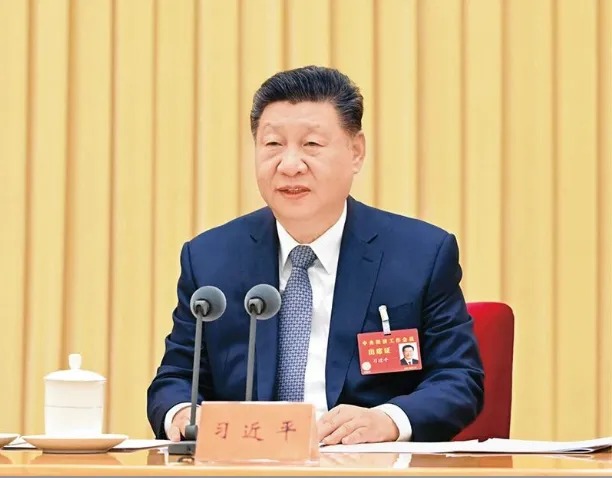
The article stresses the need to strengthen the momentum of green development, accelerate the building of a new energy system, and ensure that new electricity demand is mainly met by new energy generation. This arrangement not only establishes the dominant position of new energy in incremental energy supply, but also fundamentally unlocks new growth space for renewable energy such as photovoltaic power.
Meanwhile, the document further emphasizes the need to develop smart grids and microgrids, expand the application of green electricity, and build a number of zero-carbon parks and zero-carbon factories. This means that photovoltaic power generation will be more closely integrated into the final energy consumption system, achieve coordinated operation with the power system in major energy-consuming scenarios such as industry and construction, and provide stable and reliable clean power support for green manufacturing.
This series of policies has injected strong impetus into the photovoltaic industry, which is in a critical period of high-quality development. From meeting the rigid demand for new electricity consumption, to deeply integrating into the terminal energy consumption system and becoming a key pillar of green manufacturing, PV is not only a participant in energy transition, but will also become a major force driving green economic growth.
I. New Electricity Demand to Be Met Mainly by New Energy: Opportunities Await PV
Recently, the National Energy Administration held a national video conference on the development and construction of renewable energy power, and released the 2025 renewable energy development performance report. The data are solid, but what deserves more attention is the structural changes behind the figures.
First, let’s look at several key indicators:In 2025, China’s newly installed capacity of renewable energy reached452 million kilowatts, up 20.7% year on year, accounting for 82.5% of the total newly installed power generation capacity.In other words, of every 100 units of newly added power generation capacity last year,82.5 units came from renewable energy.
By the end of 2025, the total installed capacity of renewable energy had reached 2.337 billion kilowatts, accounting for 60% of the nation’s total installed power capacity. Its power generation hit 3.99 trillion kilowatt-hours, making up 38.5% of total society-wide electricity consumption.This means that, on average, nearly 4 out of every 10 kilowatt-hours of electricity used came from green power.
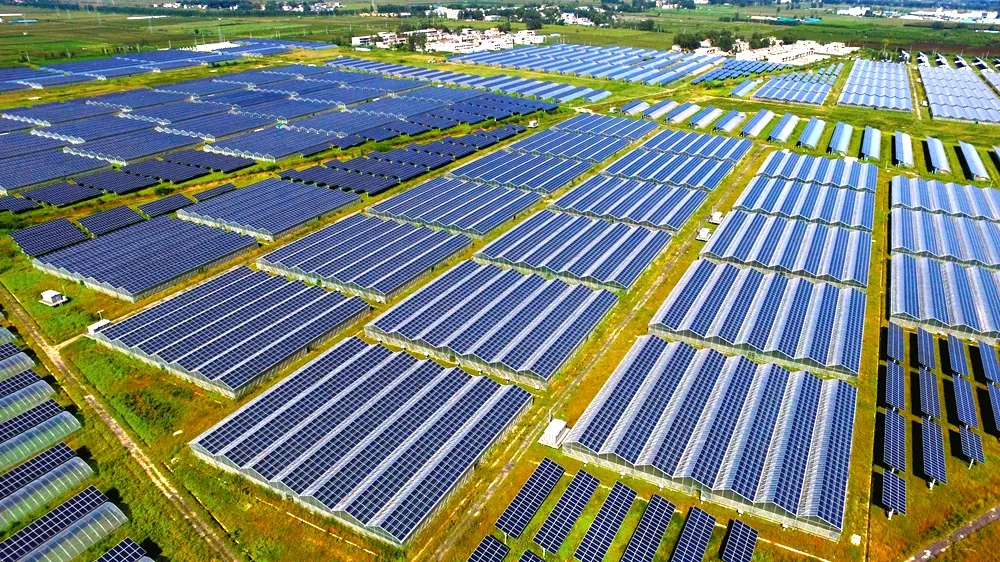
What deserves greater emphasis are two historic milestones.
First, in 2025, China’s newly installed capacity of wind and solar power reached 438 million kilowatts, including 318 million kilowatts of newly installed photovoltaic (PV) capacity. The cumulative installed capacity of grid-connected wind and solar power hit 1.84 billion kilowatts, accounting for 47% of the total, surpassing thermal power for the first time.This is a landmark moment: new energy represented by wind and solar power has moved from a supporting role to the center stage of the power system.
Second: In 2025, China’s power generation from renewable energy increased by 519.3 billion kWh year-on-year, while the increase in total society-wide electricity consumption over the same period stood at 516.1 billion kWh.This means that for every additional kWh of electricity used nationwide last year, it was fully covered by one kWh of green power.
What do these data mean for the photovoltaic industry?
In the past, when we called PV a growth sector, we focused on installation growth rate and installed capacity. Now, the logic is changing.With all new electricity demand to be met by new energy sources, PV will become the main supplier in the incremental market.
The newly installed PV capacity of 318 million kilowatts represents tangible power substitution: every kilowatt‑hour of solar power generated displaces one kilowatt‑hour of fossil fuel energy.In 2025, China’s photovoltaic power generation reached 1.17 trillion kilowatt‑hours, up 40% year on year — a growth rate far higher than that of total social electricity consumption. This is a direct reflection of incremental substitution.
New energy has achieved a historic leap, yet an even bigger chapter lies ahead.As meeting new electricity demand mainly with new energy becomes the norm, and as installed wind and solar capacity surpassing thermal power marks a new starting point, the PV industry faces more than just scale expansion.It will also need to better integrate into the power system, serve end-use energy demand, and support the green transformation of the entire economy.This is a deeper transformation, and the moment when PV truly begins to take the leading role.
II. Microgrid Breakthrough: Has the "Last Mile" of PV Consumption Been Solved?
In addition to promoting the use of new energy to meet most new electricity demand, the article also stresses the need to build smart grids and microgrids, expand the application of green power, and develop a number of zero-carbon parks and zero-carbon factories. We introduced zero-carbon factories a few days ago. So how should we understand microgrids—a term we often hear but are not quite familiar with—and how can they drive new growth in the photovoltaic industry?
First, we need to make clear: what exactly is a microgrid?
Simply put, a microgrid is a small‑scale power generation and distribution system composed of distributed energy resources, energy storage devices, energy conversion equipment, and other components. It can operate either connected to the main power grid or independently when needed. As an important platform for the efficient utilization of distributed energy, it enables local self‑generation, self‑consumption, and self‑balancing of electricity.
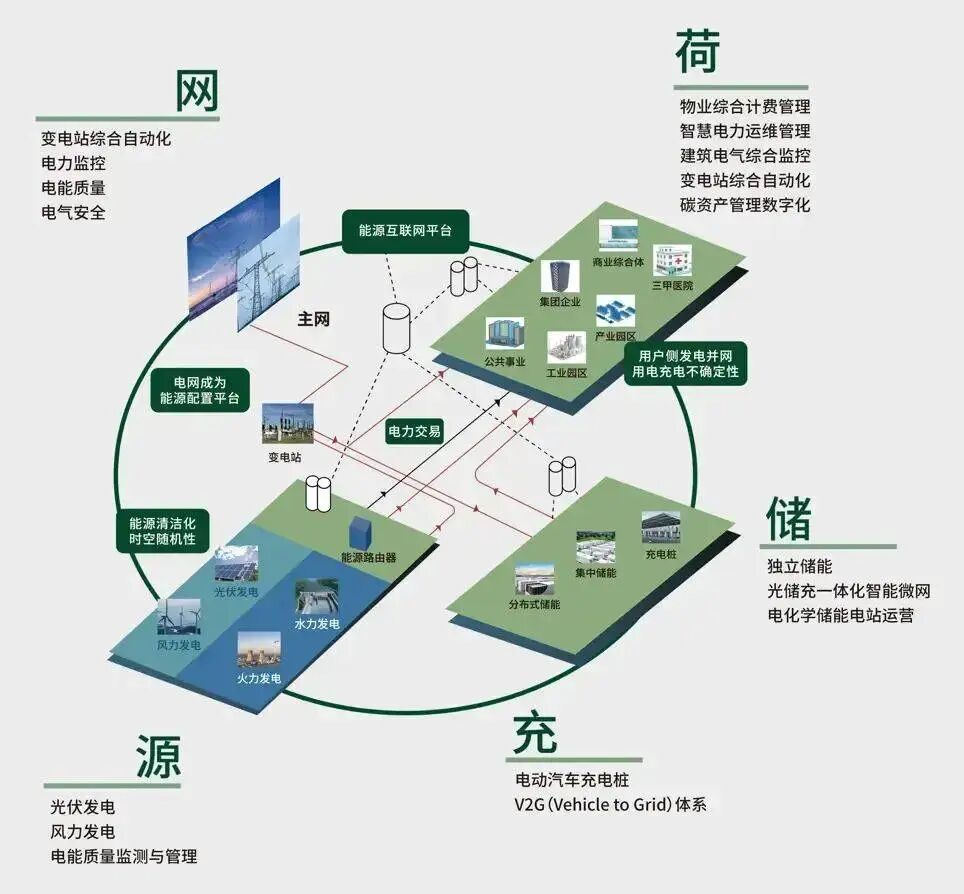
According to the Guidelines for the Construction and Application of Industrial Green Microgrids (2026–2030) jointly issued by five departments including the Ministry of Industry and Information Technology (hereinafter referred to as the "Guidelines"), an industrial green microgrid is an integrated system mainly designed to supply green power to industrial users. It integrates photovoltaics, wind power, high-efficiency heat pumps, new-type energy storage, hydrogen energy, waste heat, pressure and gas recovery, and intelligent energy management systems. Covering the generation, grid, load and storage sectors, it incorporates various new models such as incremental distribution networks, integrated generation-grid-load-storage systems, direct green power connections, and virtual power plants.
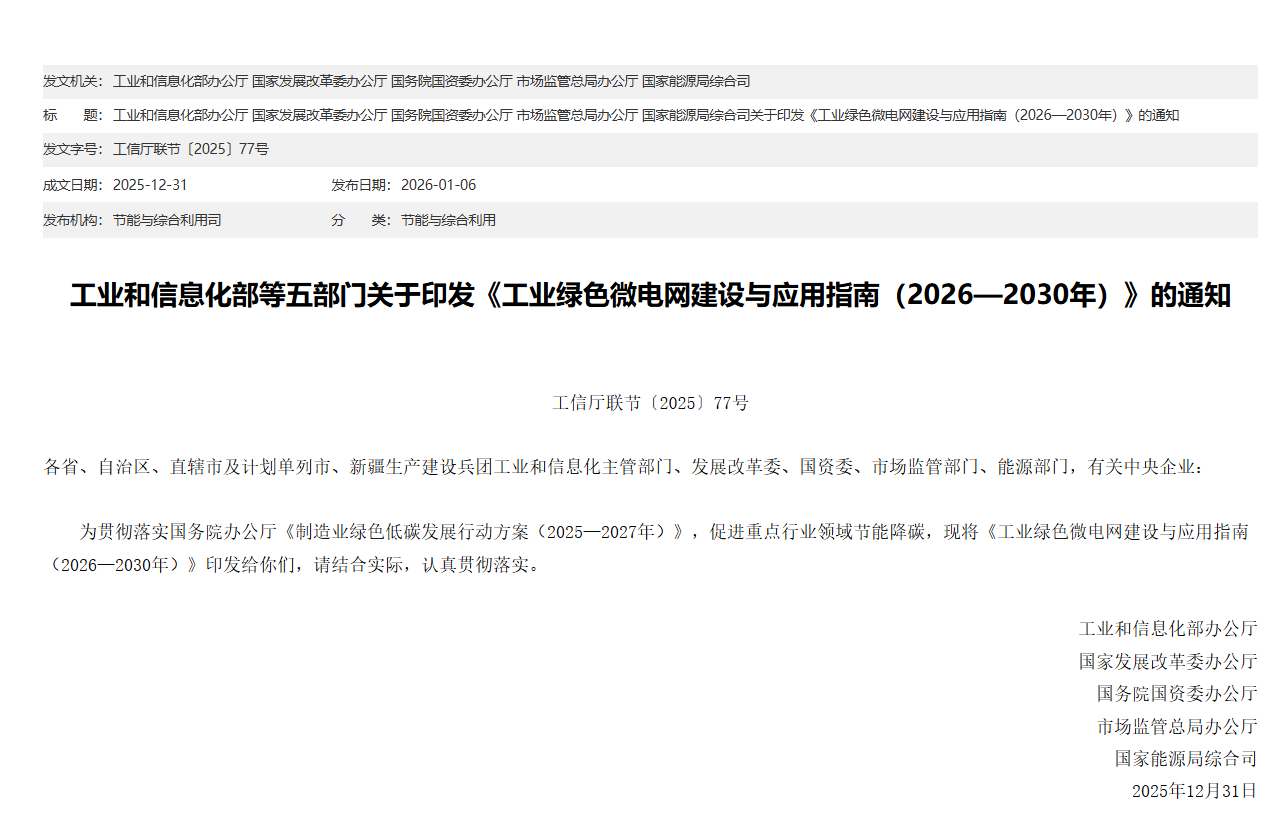
According to a survey by the Ministry of Industry and Information Technology, more than 300 industrial green microgrid projects have been put into operation nationwide, and the sector is moving from pilot demonstrations to large-scale promotion.
Since late last year, national authorities have rolled out policies intensively, opening a window of opportunity for the development of microgrids.
On December 31, 2025, the National Development and Reform Commission and the National Energy Administration jointly issued the Guiding Opinions on Promoting the High-Quality Development of Power Grids, setting the direction for the development of the entire power grid system.
The document specifies that by 2030, a new-type power grid platform will be preliminarily built, with the main and distribution power grids as the important foundation and smart microgrids as a beneficial supplement. Smart microgrids are positioned as a new form of power carrier with self-balancing and self-regulating capabilities. Their value lies in supporting the connection of diverse entities, integrating into green energy use scenarios for end users, and facilitating the nearby development and local accommodation of new energy.

Shortly after, on January 9, 2026, five national authorities jointly released the Application Guidelines, China’s first national guiding document for microgrids tailored to industrial scenarios. It sets quantifiable targets, including that “the proportion of on-site self-consumption of newly built renewable energy power generation such as solar and wind in industrial enterprises and parks shall in principle be no less than 60% annually.”
This means that photovoltaic power stations built by enterprises and parks cannot sell all their electricity to the main grid; at least 60% must be consumed locally. The core of this requirement is to ensure that green electricity is truly consumed nearby, avoiding the awkward situation of “building without consuming.”
In the past, the biggest pain point for distributed photovoltaic power was “being able to generate but not consume.” Constrained by grid access capacity and local consumption capability, many projects suffered from PV curtailment and power restrictions. The promotion of microgrids precisely solves this problem. Viewed from another angle, the 60% self-consumption requirement represents 60% stable electricity demand, creating rigid market space for industrial and commercial distributed photovoltaics.
In fact, microgrid development has been incorporated into higher-level strategic planning. The Opinions on Accelerating the Comprehensive Green Transition of Economic and Social Development issued by the Central Committee of the Communist Party of China and the State Council clearly calls for building smart grids and accelerating the development of microgrids, virtual power plants, and integrated generation-grid-load-storage projects.
In addition, the latest 15th Five-Year Plan stresses accelerating the construction of smart grids and microgrids, raising the electrification level of end-use energy, and promoting greener and low-carbon energy consumption. Coupled with the deployment to expand green power application at the recently held Central Economic Work Conference, these documents together form the policy foundation supporting the rapid development of microgrids. An era of microgrids is accelerating.
III. Broad Prospects, Yet Steady Steps Needed for Solid Progress
Looking back, the energy transition arrangements laid out in Key Tasks for Current Economic Work have indeed opened up unprecedented growth space for the photovoltaic industry.
Meeting new electricity demand with new energy means PV is no longer a "supplement" to the power system, but the main force in the incremental market. The accelerated rollout of microgrids allows PV to be more deeply integrated into factories and industrial parks, becoming basic infrastructure for green manufacturing. A package of policies — including zero-carbon factories, the carbon market, and low-carbon transition funds — is paving the way for monetizing the environmental value of green electricity. It is fair to say that from scale expansion to value restructuring, the photovoltaic industry is embracing a brand-new era.
Yet the more promising the outlook, the more we need to stay level-headed.
Surpassing thermal power in installed capacity is only the beginning. The real test going forward is whether photovoltaic power can be effectively and stably utilized. At present, the problem of PV curtailment and power restrictions still exists in some regions, and the power grid’s capacity to accommodate a high share of new energy remains constrained. Although the promotion of microgrids has policy guidance, business models are still being explored. Many enterprises still doubt whether investing in microgrids is economically viable. While the 60% self-consumption requirement has been set, ensuring implementation and balancing corporate energy costs with green power consumption demands more detailed supporting policies.
More importantly, the PV industry itself faces growing pains: phased overcapacity, intensifying price competition, and rising barriers in overseas markets. These tangible challenges will not disappear simply because of favorable policies. To shift from policy-driven to market-driven, and from scale expansion to high-quality development, the PV sector still has many hurdles to overcome.
The wind of policy is already blowing, but what will truly sustain the long-term development of photovoltaics is not short-term policy enthusiasm, but solid technological progress, mature business models, sound market mechanisms, and the effective implementation and operation of every single project.
