


Views: 0 Author: Site Editor Publish Time: 2026-03-26 Origin: Site


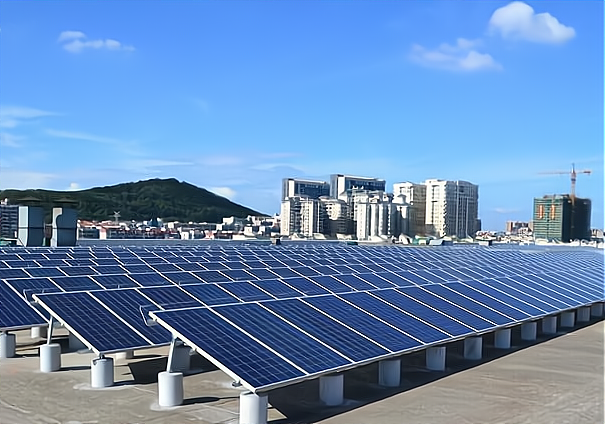
A component, with a nominal power of 550 watts, is actually only 530 watts. Just because of this small nameplate, several million yuan was "stolen" from a 100-megawatt power station.
This is no industry secret. This is a true story that a purchasing manager of a certain photovoltaic power station encountered when inspecting a project last year. The supplier spoke with confidence: "Everyone in the industry does it this way. It's quite normal to have a difference of several dozen watts." " The manager was so angry that he wanted to curse, but the contract only stated "meeting industry standards" - and industry standards happen to have no binding force.
Three months later, the power station was hit by strong winds and more than twenty components were overturned. Upon opening it, it was found that the thickness of the frame wall was significantly thinner than normal - the standard requirement was 2.0 millimeters, but in reality, it was only a little over 1.6 millimeters. Fine lines visible to the naked eye also appeared on the back panel. And this is just one of the countless stories of quality degradation amid the "intra-industry competition" in the photovoltaic sector.
But after March 24, 2026, such stories may come to an end.
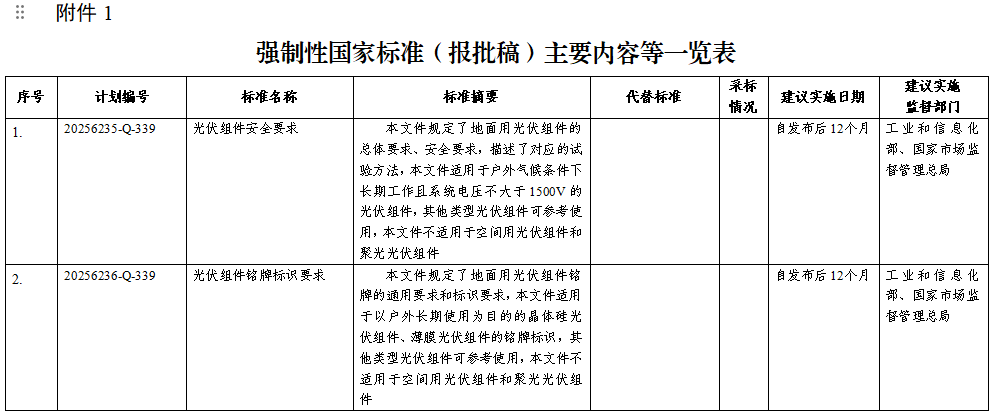
On March 24th, the two mandatory national standards of the Ministry of Industry and Information Technology, namely "Safety Requirements for Photovoltaic Modules" and "Requirements for Nameplate and Marking of Photovoltaic Modules", officially entered the public display of the draft for approval. Note that it's "mandatory", not "recommended". This means that from now on, anyone who engages in "false power labeling" or cuts corners will no longer face merely a superficial "public criticism", but rather real administrative penalties, product removal from shelves, and even license revocation.
I. How did we get ourselves to this point?
China's global market share of photovoltaic products has reached over 70%, with leading technology and the world's largest installed capacity. It is absolutely far ahead.
But in the past two years, the style has changed.
The price of components dropped from 1.8 yuan per watt to 1 yuan, and then fell below 0.7 yuan. Someone shouted, "It's below cost!" But it couldn't stop someone from continuing to lower the price. Why? Because the price is not reduced, the production capacity will be idle. If the production capacity is empty, the money from the bank cannot be repaid.
Thus, a fierce "intra-industry competition" began. In the end, when it comes to competing on price, it all comes down to cost. To reduce cost, the quickest way is to cut the configuration.
The glass should be thinner, the frame thinner, and one less layer of adhesive film. These differences are simply imperceptible to the naked eye. But what about after the installation?
Data from the National Solar Photovoltaic Product Quality Inspection and Testing Center shows that in 2019, the pass rate of random inspections of photovoltaic modules was still 100%. By 2024, this figure had dropped to 62.9%. That is to say, for every three components on the market, more than one has problems.
The problems are concentrated in three areas: first, the power is falsely marked; second, the mechanical load is insufficient; and third, the materials are of poor quality. After 2024, news about photovoltaic power stations catching fire and components being overturned by strong winds has been trending on social media from time to time. During the fire investigation, it was found that the fundamental cause of some fires was that the junction boxes inside the components were made of inferior materials, which led to spontaneous combustion due to long-term heating.
This is not the most fatal thing. The most fatal thing is that inferior products have tarnished the reputation of the industry. Financial institutions have become more cautious in assessing photovoltaic power stations, and loan interest rates have risen. Insurance companies are setting increasingly higher prices for component quality risks. Overseas, there are also a few low-quality components that "spoil the whole pot with one bad apple", gradually eroding the credibility we have painstakingly built up.
In the end, there are no winners in such "intra-industry competition", and the entire industry loses together.
II. nameplates no longer "deceive" people. They should be exactly as they are marked
Among the two mandatory standards, the "Requirements for Nameplate Marking of Photovoltaic Modules" targets the false marking of power.
A component labeled as 550 watts was actually measured to be only 530 watts. At a component price of 0.7 yuan per watt, for a 100-megawatt power station, the owner is equivalent to being "secretly reaped" several million yuan.
What is frustrating is that this kind of false labeling is not a technical issue at all, but rather "deliberately leaving room for maneuver". Some enterprise personnel privately said, "It's not that we can't do it; it's just that everyone is doing this. If you don't do it, you'll be at a disadvantage." When bidding, people look at the numbers on the nameplate. Who cares how much you actually measure?
But now, Qiangbiao has directly cut off this path.
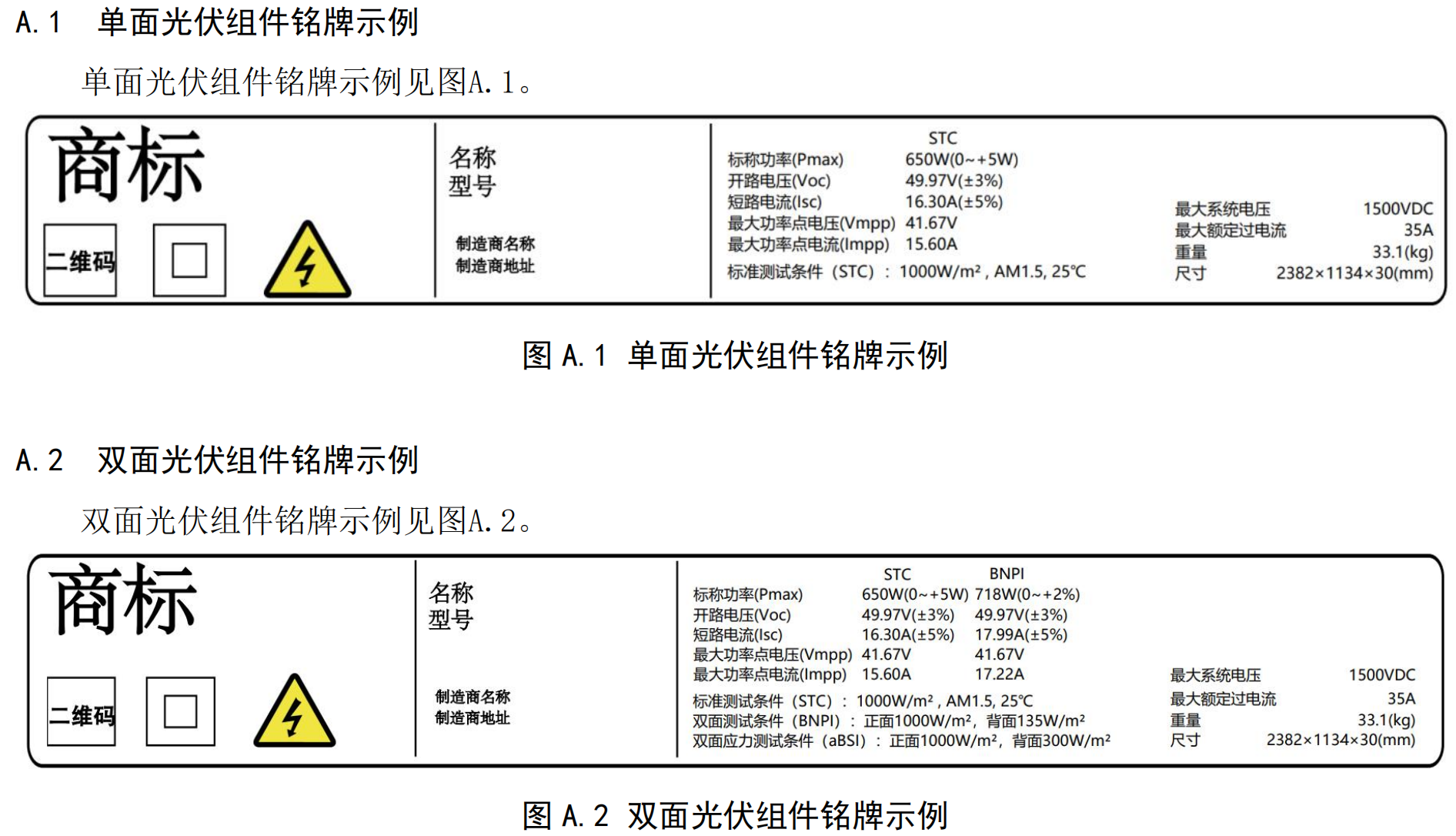
The new standard stipulates that the nominal power must be marked with tolerance, and the measured deviation value cannot exceed the upper and lower limits of the tolerance, or the smaller value within ±2%.
This means that if your nameplate states 550 watts ±2%, then the measured value cannot be lower than 539 watts. If you write 550 watts ±0%, then the measured value must be 550 watts. Even a slight difference won't do.
For thin-film modules and perovskite modules, considering the technical characteristics, the tolerance is relaxed to ±5%. However, in any case, every number on the nameplate must stand up to the verification of third-party testing.
III. safety is not a "multiple-choice question". If the glass breaks, one's life might be lost
Nameplates address the issue of "integrity", while the "Safety Requirements for Photovoltaic Modules" address the issue of "saving lives".
The new safety standards cover all aspects from electrical safety to mechanical load, from fire resistance performance to environmental adaptability. Each one is a lesson learned from an accident.
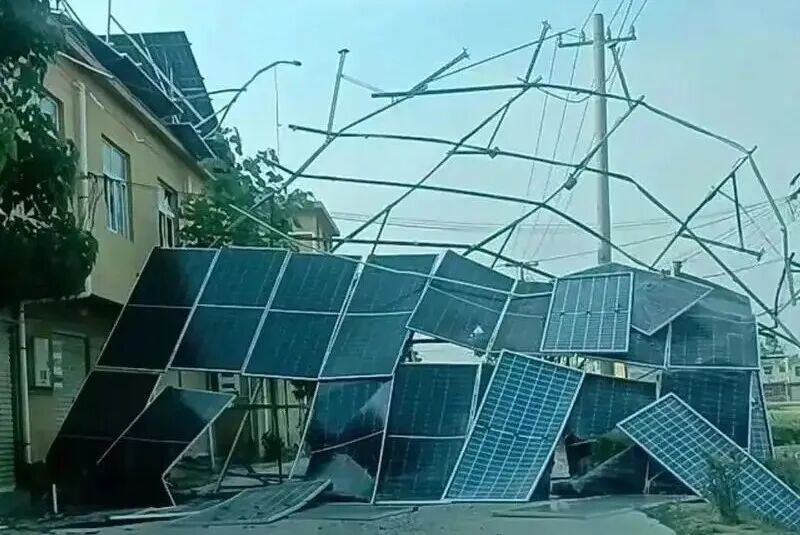
In the summer of 2024, a strong wind blew off dozens of components of a photovoltaic power station in a certain area of Shandong Province, damaging the nearby civilian houses. Fortunately, no one was hit. Post-event inspection revealed that the wall thickness of the frame of this batch of components was nearly 0.4 millimeters less than the standard requirement, and their wind resistance was simply insufficient.
In the winter of 2025, a rooftop power station in Jiangsu Province suddenly caught fire, and the flames spread throughout the entire factory building. The investigation conclusion is that the backsheet material of the component has aged, its insulation performance has declined, and it eventually short-circuited and caught fire.
There are even more concealed ones - for some component junction boxes, after continuous operation in a high-temperature environment for several years, the solder joints become loose, the contact resistance increases, they keep heating up, and eventually catch fire spontaneously.
Not all "bargains" are worth taking. The cost saved might lead to fires at power stations, casualties, and even the collapse of the entire industry's reputation.
IV. Mandatory Standards, not "Paper tigers"
In the past, many standards in the photovoltaic industry were "recommended", meaning that you could follow them or not. The self-discipline convention is also signed voluntarily. Those who have signed it find that others have gained an advantage by not signing it, and they themselves also follow suit and do not abide by the rules. This is what is called "bad money driving out good money".
But mandatory national standards are different. It is law.
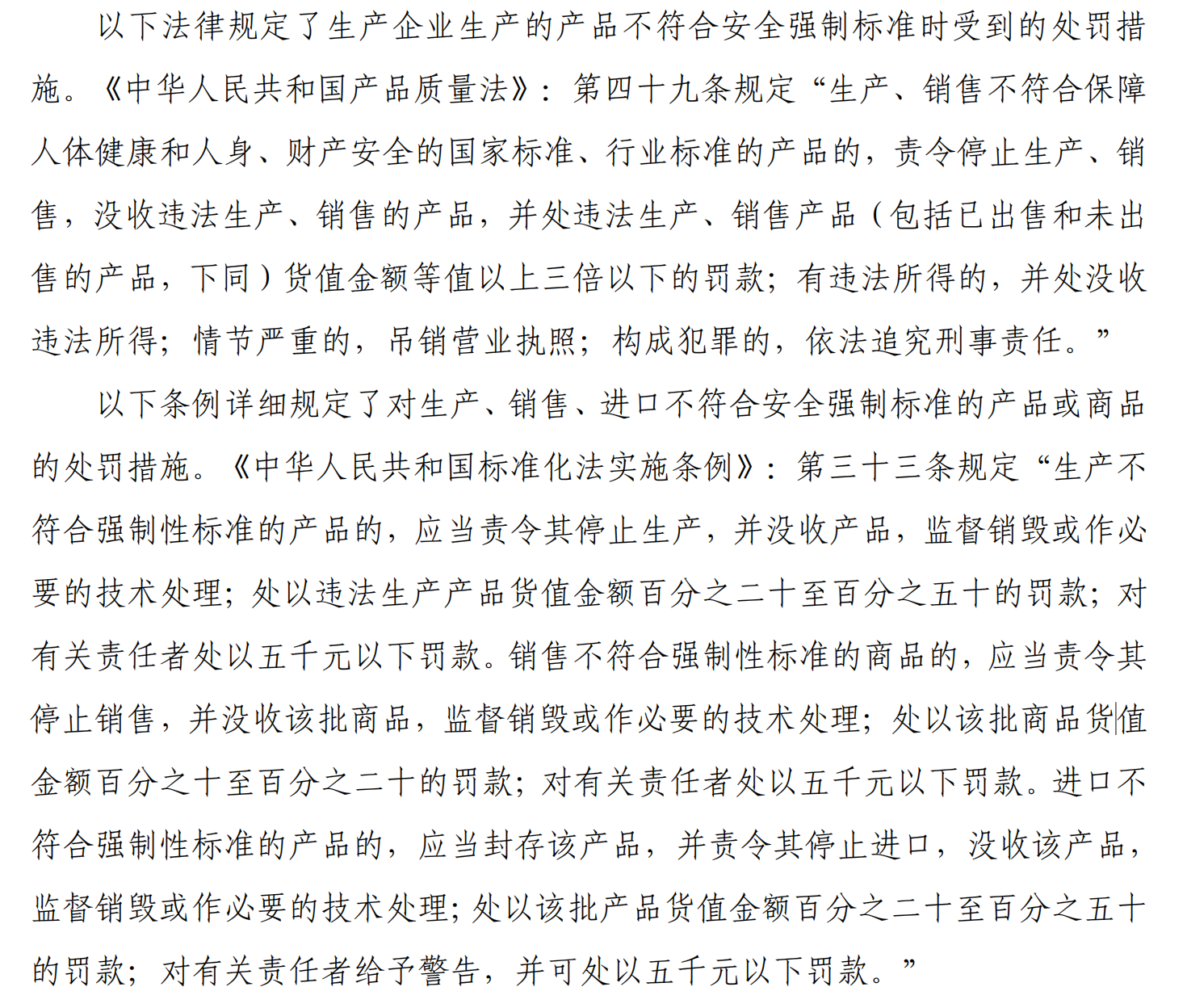
China's Standardization Law clearly stipulates that products that do not meet mandatory standards shall not be produced, sold or imported. What are the consequences of breaking the law? Confiscate illegal products, impose fines, order to suspend production and business operations, and revoke business licenses in serious cases. How serious? Criminal responsibility may be pursued.
This is not to scare people. The public announcement period is only one week, from March 24th to March 30th. After the feedback is completed, it will be officially released soon. According to the standard plan, after the release of the two mandatory standards, they will be implemented respectively - the "Safety Requirements for Photovoltaic Modules" will have a 12-month transition period, and the "Requirements for Nameplates and Markings of Photovoltaic Modules" will have a 6-month transition period. After the transition period expires, all photovoltaic modules sold in the Chinese market must comply with the corresponding mandatory standards.
That is to say, the time left for enterprises to rectify is only half a year to one year. After that, those enterprises that relied on low prices and poor quality, falsely labeled power, and cut corners to survive either had to transform or be eliminated.
V. Farewell to "Intra-Industry Competition" : Where Is the Way Forward?
Some people are worried: With standards tightened and costs rising, will the industry suffer even more?
The box believes the opposite. The significance of a strong target lies in ending the vicious cycle of "bad money driving out good money".
As some leaders of photovoltaic enterprises have put it: In the past, we wanted to achieve high quality, but when bidding, they only looked at the price. No matter how good your product was, if the price was just ten cents higher, you would be eliminated. If the standards hold the bottom line and no one can cut corners anymore, then we can focus on quality with peace of mind.
Mandatory standards are not about putting shackles on the industry, but about paving the way for enterprises that truly possess technology and a good conscience.
On March 19, 2026, at a symposium before the standards were made public, Xiong Jijun, vice minister of the Ministry of Industry and Information Technology, put it more directly: The formulation and implementation of these two strong standards is "an important measure to balance development and security and break the disorderly competition in industries", and also "an inevitable requirement for promoting high-quality industrial development".
He particularly mentioned that when making purchases, central state-owned power generation enterprises should proactively align with the new standards and no longer blindly pursue low prices. This means that from the supply side to the demand side, the entire industrial chain is responsible for quality.
Zhong Baoshen, a deputy to the National People's Congress and the chairman of Longi Green Energy, also talked about this issue during this year's Two Sessions. He said that the root cause of the "intra-industry competition" is that everyone is focused on scale expansion. Now, a "new yardstick" must be used to guide competition. What is the new ruler? It's about conversion efficiency, it's about safety, it's about reliability.
When quality becomes the sole pass, it is believed that no one will care about the price difference of a few cents.
