


Views: 0 Author: Site Editor Publish Time: 2026-07-01 Origin: Site


Rigid solar panels present significant engineering limitations for specialized projects. Weight restrictions, non-planar surfaces, and strict structural load capacities often disqualify traditional glass-and-aluminum modules from being used on older commercial roofs, marine vessels, RVs, and custom industrial applications. Deploying renewable energy in these environments requires an alternative approach where heavy racking systems are structurally prohibited. Evaluating the technical merits of a lightweight flexible solar module provides a viable pathway forward. Understanding the material trade-offs, aerodynamic benefits, and implementation realities dictates project feasibility and long-term return on investment. By shifting away from bulky mechanical mounts, engineers can leverage advanced polymers and high-efficiency silicon to generate power exactly where it is needed without compromising structural integrity.
Drastic Weight Reduction: Flexible modules weigh up to 80% less than traditional glass-and-aluminum panels, enabling installation on older structures and mobile platforms without costly structural reinforcement or regulatory compliance barriers.
Ultra-Thin Profile & Aerodynamics: With thicknesses often under 3mm, these panels conform to curved surfaces and eliminate wind uplift/drag risks.
Installation Versatility: The ability to conform to curved surfaces and utilize adhesive mounting eliminates the need for penetrating roof mounts, specialized heavy rigging, and heavy racking hardware.
Efficiency vs. Thermal Trade-offs: While modern monocrystalline flexible panels offer high efficiency (15-18%+), flush mounting requires proactive thermal management to prevent heat-induced performance degradation.
System Integration Requirements: To function effectively as eco-friendly off-grid energy banks, flexible modules require careful pairing with compatible charge controllers and battery storage systems.
Application-Specific Customization: Advanced manufacturing allows for custom sizing, custom voltage configurations, and adaptable mounting setups, making flexible panels highly adaptable for specialized off-grid and OEM integrations.
Traditional rigid solar arrays impose substantial dead loads on building structures. A standard glass panel combined with aluminum racking typically weighs between 15 and 20 kg/m². Older industrial facilities and warehouses frequently fail structural load assessments for these systems. They cannot support ballasted arrays safely without undergoing massive structural overhauls. A lightweight solar panel drastically alters this equation. Flexible alternatives weigh approximately 2 to 3 kg/m². This massive weight reduction eliminates the need for expensive structural reinforcement. Bypassing heavy structural upgrades simplifies building permitting and accelerates local regulatory approvals for commercial installations. When you remove the need for heavy metal racking, the entire logistics chain becomes leaner. You spend less time waiting for structural engineering sign-offs and more time actually generating power.
Consider the impact on older corrugated metal roofs or aging membrane roofs. These structures were designed to hold snow loads and withstand local wind conditions, not to support tons of glass and aluminum. By utilizing lightweight technology, facility managers can activate previously unusable roof space. The structural math is straightforward: reducing the dead load by 80% opens up thousands of square feet for renewable energy deployment. This approach also minimizes the seismic mass added to the top of a building, which is a critical factor in earthquake-prone regions.
Metric | Traditional Rigid Panel + Racking | Lightweight Flexible Module |
|---|---|---|
Average Weight (kg/m²) | 15 - 20 kg/m² | 2 - 3 kg/m² |
Structural Reinforcement | Often Required for Older Roofs | Rarely Required |
Permitting Complexity | High (Requires detailed load analysis) | Low (Minimal dead load added) |
Seismic Impact | Significant top-heavy mass | Negligible |
Transportation, RV, and marine sectors demand strict aerodynamic efficiency. Drag reduction remains critical for fuel economy and vehicle stability. Flexible modules feature an ultra-thin profile, typically measuring under 3mm in thickness. This low-profile design eliminates wind shear and mitigates wind-uplift risks on high-wind industrial roofs. Architectural integration expands significantly with this technology. Installers can deploy solar arrays on curved roofs, domes, fabric structures, and unconventional infrastructure where rigid panels simply cannot fit. The ability to bend up to 30 degrees allows these panels to hug the contours of an Airstream trailer, a sailboat bimini, or a curved architectural canopy.
Wind uplift is a major failure point for traditional solar arrays. When wind catches the underside of a tilted rigid panel, it acts like a sail, putting immense stress on the mounting hardware and the roof itself. Flush-mounted flexible panels eliminate this risk entirely. Because they sit flat against the surface, there is no gap for the wind to catch. This makes them exceptionally well-suited for hurricane-prone areas or high-altitude installations where wind speeds routinely exceed standard building code limits.
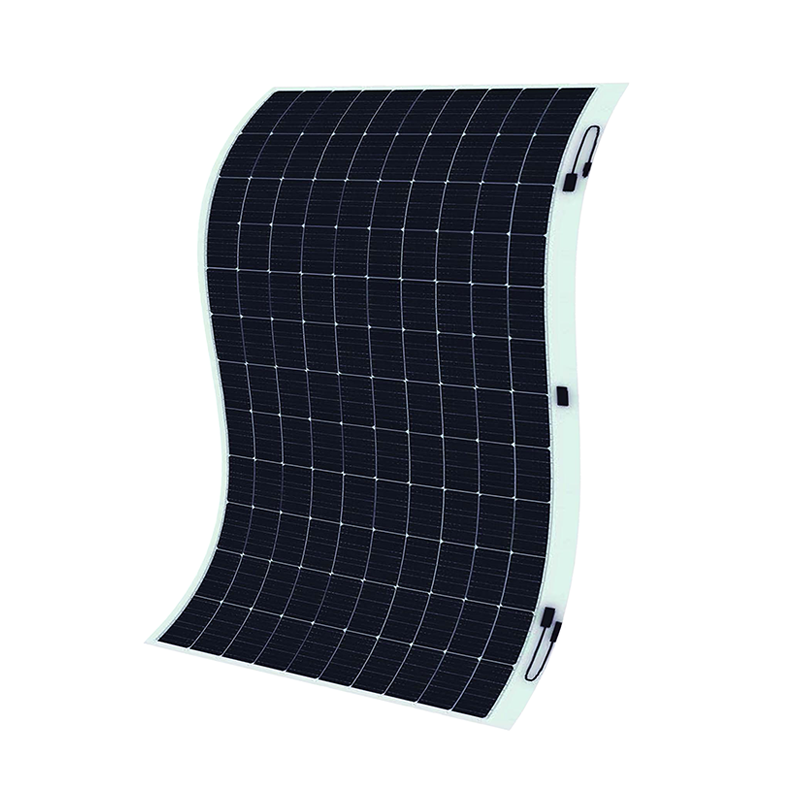
Mounting flexible modules shifts the paradigm from mechanical, penetrating mounts to non-destructive methods. Installers utilize industrial adhesives, VHB tape, magnetic backings, and grommet-based systems. This approach heavily reduces on-site labor hours. It completely eliminates the need for specialized heavy rigging equipment, cranes, and roof penetrations. Soft costs drop accordingly. These systems also offer high DIY-friendliness, lowering the barrier to entry for small-scale commercial and residential off-grid setups. You no longer need a team of six people to haul panels up a ladder; a single technician can easily carry multiple flexible panels under one arm.
Clean and prep the installation surface using a specialized degreaser or isopropyl alcohol to ensure maximum adhesive bonding.
Apply continuous strips of marine-grade double-sided tape (such as 3M VHB) or a structural silicone adhesive to the back of the panel.
Position the panel carefully, as high-bond adhesives grab instantly. Apply even pressure across the entire surface using a heavy roller to eliminate air pockets.
Seal the perimeter edges with a UV-resistant polyurethane sealant to prevent moisture ingress and edge delamination over time.
Historically, flexible thin-film panels suffered from low efficiency, hovering around 10-12%. Modern manufacturing bridges this gap. Integrating a flexible solar module utilizes advanced monocrystalline silicon cells. These contemporary units reliably achieve 15-18% efficiency or higher. Energy yields remain competitive in variable weather conditions. Degradation rates have improved, ensuring stable output metrics even in challenging low-light environments. The shift from amorphous silicon to monocrystalline structures means you get significantly more power per square inch, which is vital when roof space or deck space is limited.
A flexible mono solar module utilizes the same high-grade silicon wafers found in premium residential rigid panels. The difference lies in the encapsulation process. Instead of heavy glass and EVA, the cells are sandwiched between layers of advanced polymers. This allows the cells to flex slightly without breaking, while still capturing sunlight with high efficiency. Bypass diodes are integrated into the junction boxes to minimize power loss during partial shading, which is a common occurrence on sailboats with rigging or RVs parked under trees.
Remote deployments, disaster relief operations, and expeditionary missions benefit immensely from lightweight solar logistics. Teams can easily carry, mount, and reposition panels in temporary tactical setups. Integrating an off-grid solar module requires proper system architecture to function as a reliable energy bank. You must pair these panels with compatible solar charge controllers. MPPT (Maximum Power Point Tracking) controllers maximize energy harvest better than traditional PWM options. Proper battery storage setups ensure the captured energy remains available during non-sunlight hours.
When designing an off-grid system, the wiring architecture is just as important as the panels themselves. Flexible panels often come with standard MC4 connectors, making them plug-and-play compatible with most modern solar generators and charge controllers. For marine environments, it is critical to use tinned copper wire to prevent corrosion. The flexibility of the panels means they can be temporarily deployed on a bimini top while at anchor, and then easily unclipped and stowed below deck when underway.
Original equipment manufacturers frequently require specific form factors for product integration. Specifying a custom flexible solar panel allows precise matching to product contours. Manufacturers can tailor voltage outputs, physical dimensions, junction box placements, and connection cables. This adaptability serves specialized industrial equipment, marine vessels, and consumer products perfectly. Instead of designing a product around a standard solar panel size, engineers can design the product first and have the solar panel manufactured to fit the available space.
This level of customization extends to the electrical characteristics as well. If a specific piece of telemetry equipment requires a 24V input, the flexible panel can be wired internally during manufacturing to deliver exactly that voltage, eliminating the need for bulky step-up converters. Junction boxes can be moved from the top edge to the back of the panel for a completely flush, wire-free aesthetic on the top surface. This is particularly popular in high-end marine and automotive applications where visual design is paramount.
Surface coatings dictate the lifespan of flexible modules. The industry primarily uses ETFE (Ethylene Tetrafluoroethylene) or PET (Polyethylene Terephthalate). ETFE offers superior chemical composition, exceptional UV resistance, and high light transmittance. It resists scratching and environmental degradation. PET alternatives cost less but degrade rapidly under harsh sunlight. ETFE is mandatory for marine, high-salinity, or high-UV industrial environments to prevent premature delamination. The textured surface of ETFE also provides a slight anti-reflective property, helping to capture angled sunlight during the early morning and late afternoon.
When evaluating panels, you can often tell the difference by touch. PET panels have a smooth, glossy finish that scratches easily and tends to turn cloudy or yellow after a few years of UV exposure. ETFE panels have a slightly dimpled, textured surface that feels robust. This dimpling not only increases durability but also creates a self-cleaning effect when it rains, washing away dust and bird droppings that would otherwise shade the cells and reduce power output.
Feature | ETFE Coating | PET Coating |
|---|---|---|
UV Resistance | Excellent (Long lifespan, no yellowing) | Poor (Prone to yellowing and clouding) |
Light Transmittance | High (~95%) | Moderate (~85-90%) |
Durability | High scratch and chemical resistance | Low scratch resistance, prone to delamination |
Surface Texture | Dimpled, self-cleaning, anti-reflective | Smooth, glossy, prone to glare |
Best Application | Marine, Industrial, High-UV, Permanent | Temporary setups, budget projects |
While the upfront cost-per-watt of flexible panels may be higher than mass-produced rigid panels, the total system cost is often lower. This is due to eliminated racking hardware, drastically reduced labor hours, and lower shipping costs. A pallet of flexible panels weighs a fraction of a pallet of glass panels, cutting freight expenses significantly. When calculating ROI, you must factor in the application lifespan, maintenance cycles, and system-level installation savings. If a rigid system requires a $20,000 structural roof upgrade before installation, the slightly higher cost of flexible panels becomes the clear financial winner.
Furthermore, the speed of installation means less downtime for commercial facilities. A team can adhere hundreds of flexible panels to a membrane roof in the time it takes to assemble and ballast a single row of rigid racking. This rapid deployment translates directly to lower labor costs and a faster path to generating usable electricity. Maintenance is also simplified; there are no bolts to re-torque and no metal racks to inspect for rust or corrosion.
The primary drawback of flush-mounted flexible panels is the lack of a rear air gap for convective cooling. Solar cells lose voltage as temperatures rise. Flush mounting traps heat against the installation surface. Mitigation requires proactive design. Use structured adhesives that create micro-channels for airflow. Twin-wall polycarbonate backing sheets can facilitate back-side heat dissipation. Strategic structural placement also helps manage thermal loads effectively. If you are mounting on a metal roof, the roof itself can act as a giant heat sink, pulling thermal energy away from the panel.
Understanding the temperature coefficient of the specific monocrystalline cells used in your panels is crucial. High-quality cells will have a lower temperature coefficient, meaning they lose less power as they heat up. If you are installing in a desert environment, consider mounting the flexible panels on a lightweight composite frame that allows just a half-inch of airflow underneath. This small modification can restore 5-10% of the panel's efficiency during peak afternoon heat.
Flexible panels contain delicate internal silicon cells. Exceeding the maximum bend radius guidelines will fracture these cells, causing permanent power loss. Establish strict handling, transport, and installation best practices. Avoid point-load stress entirely. Never walk on flexible panels unless the manufacturer explicitly rates them as marine-grade walkable. Even then, they must sit on a perfectly flat, rigid substrate to prevent micro-cracking. A deck with a slight bow or uneven fiberglass will create pressure points that snap the silicon wafers when stepped on.
During installation, technicians must be trained not to carry the panels by a single corner, which causes the panel to whip and flex violently. Always carry them with two hands supporting the long edges. When pressing the panels into the adhesive, use a wide, soft roller rather than pressing down hard with the heel of your hand. These small handling details make the difference between a system that lasts 15 years and one that fails in the first month due to invisible internal micro-cracks.
Flexible modules do not universally replace rigid panels for standard utility-scale solar farms. However, they stand as the definitive engineering solution for weight-constrained, curved, or highly mobile environments. Decision-makers should prioritize ETFE surface coatings, monocrystalline cell architecture, and verified thermal performance data during the selection process. By understanding the specific mounting requirements and thermal management strategies, you can deploy robust off-grid power systems in locations previously thought impossible.
Conduct a thorough structural load assessment of your target installation site to confirm weight limitations and surface compatibility.
Define your exact wattage and voltage requirements based on your daily energy consumption and battery bank capacity.
Consult with a specialized manufacturer to design a custom module layout tailored to your specific surface dimensions and electrical needs.
Select an MPPT charge controller and appropriate lithium or AGM battery bank to maximize off-grid system efficiency.
A: High-quality ETFE-coated flexible panels typically last 10 to 15 years. UV exposure and thermal cycling impact their longevity more severely than rigid panels, which often exceed 25 years. Proper installation and thermal management help maximize their operational lifespan.
A: Flexible panels are typically 70-80% lighter than rigid alternatives. A flexible module averages 2 to 3 kg/m², whereas a traditional rigid panel with its required racking system averages 12 to 20 kg/m².
A: Some marine-grade panels are marketed as walkable, but strict conditions apply. The panel must be installed on a perfectly flat, rigid substrate. You must wear clean, soft-soled shoes to prevent point-load stress and internal cell micro-cracking.
A: Mounting depends on the surface. Use marine-grade sealants or specialized double-sided tapes like 3M VHB for permanent flush mounts. Heavy-duty outdoor hook-and-loop fasteners work for repositionable needs, while mechanical fasteners via edge grommets suit canvas or structural frames.
A: Yes. Solar panels produce fluctuating DC power based on sunlight. A charge controller, preferably MPPT, regulates this voltage. A battery bank, such as lithium or AGM, stores the energy to provide stable, continuous power to your appliances.
A: Solar cells have a temperature coefficient, meaning their voltage drops as heat increases. Flush-mounted flexible panels lack rear airflow, leading to higher operating temperatures. This results in a temporary drop in overall power output during peak heat hours.


